Op Art History Characteristics of Optical or Retnal Art
Hypnotizing, mesmerizing, fascinating, mind-boggling! Op Fine art, aka Optical Fine art, is all that and more. Artists had long been interested in the visual imagery that captivates and deceives the eye, yet it wasn't until the 1960s that such interest flourished into a proper art movement of a popularity that goes across today. Whether they are strictly black and white or oozing with color, Op artworks can appoint our attending like no others, cheers to their many historical roots and an evergreen vision.
What Is Op Fine art?
- Short proper name for Optical
- Art Abstract Fine art from the 1960s
- Pure visual illusion
- "A collision of art and science"
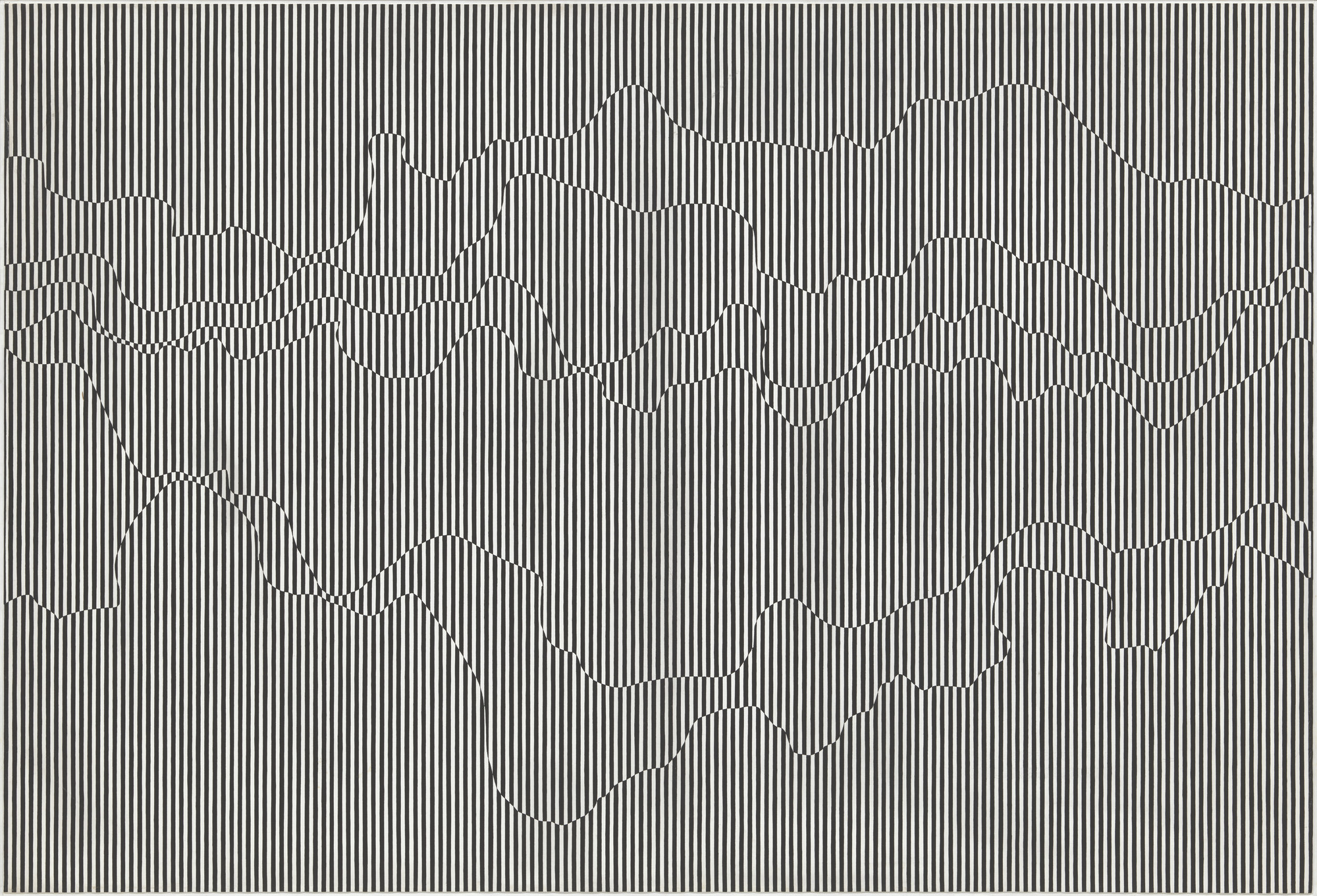
Speaking in purely visual terms, Op Art or Optical Art is a style of the visual arts, specifically (geometric) Abstruse Art, that deals with optical illusion. But unlike Kinetic Art, a field it is also a part of, it only evokes movement instead of actually endorsing it, in order to fool the center and illicit a kind of reaction, sometimes fifty-fifty nausea. And so, to achieve it, Op artists opt to employ abstract geometric shapes to play with perspective, and thick blocks of black, white, or usually vibrant colors to create irregular patterns and chromatic tensionsouth - which are perceived past our retina every bit flashing, vibration, microscopic movement, warping. In that location are many characteristics that make Op Art images and paintings, which is the move's primary medium, stand up out. These are quite not-representational, meaning that they depict the metaphysical rather than the "existent". They rely on negative infinite, strong contrasts, the figure-ground relationship between the foreground and the background, and precise mathematical calculations to attain their perceptual consequence, at the aforementioned time creating an unmissable three-dimensional quality. At dissimilar scales, they were created past some of the well-nigh prominent modernistic and Contemporary Artists in History with legacies yet to stop inspiring.

Op Art Definition...
Op art employs Illusionism and other optical games, giving an advent of motion to shapes, colours and patterns. With stiff black, grey and white contrasts and the funny vibration of complementary flat colours, this branch of Kinetic Fine art appeared in the mid-1960s and prevailed. Experimenting new materials - acrylic with oil, plaster, Plexiglas, plastic, polyvinyl, wire, string, aluminium and iron - and using only lines, bands and patterns, Op Artists favoured a cold and impersonal execution which stimulates our vision and inspires wonder. These artists established a totally new relationship between the observer and a work of art.
Op Art's history: "The target is not the heart but the retina"
Op Art traces its roots dorsum in 19th-century art and colour theory, Johann Wolfgang von Goethe's studies of colour and Georges Seurat'due south Pointillism and Impressionism's unique perception of the world. The Onetime Masters' effect known equally the trompe l'oeil (French for "play a joke on the center") is often associated to the illusion created past Op Fine art, which, also, recalls M.C. Escher's hypnotizing drawings and patterns.On September 1964, an exhibition titled "Julian Stanczak-Optical Paintings" in New York, at the prestigious Martha Jackson Gallery, opened its doors to the term, Op Art. The championship was just "something for the art critics to chew on", said the gallerist. The new fine art motility became "a big affair", similar Pop Art, only after information technology was mentioned in an article in Time Magazine, "Op Art: Pictures that Assault the Heart appeared".

© 2007 Akiyoski Kitaoka © 2007 KANZEN, © Domino Recording Co. Ltd, 2009
While the various forms of Abstract Expressionism were progressively oriented towards conventionality, an fine art, more linked to the realm of vision, made a improvement. The exhibition "The Responsive Centre", held at New York'south Museum of Modem Art - MoMA in 1965, has consecrated the Op Fine art movement, by presenting its landscape and unlike trends. Bridget Riley (Britain), Victor Vasarely (France/Hungary) and Jesus Rafael Soto (Venezuela) were the 3 "Top Op artists". Others, like Kenneth Noland, Larry Poons, Frank Stella and Ellsworth Kelly, escape the traditional designation of Op artists. Latin American artists - the Brazilian vanguardists Hélio Oiticica and Lygia Pape - played a key part in Op Fine art, calculation mysticism and erudite concepts to it. The practice of this relatively new method has become widespread. Artists from Germany, Italy, Canada, and the Argentine and Equipo 57, a group of artists in Spain, had nearly identical technical approaches to Op Art. From the moment Op Art was on anybody'due south lips, information technology suffered from a strong backlash, caused by a major misunderstanding. Op Art avoided Popular Art's criteria (subjects, coloration and "coolness") and emotional expressionism. Op Art seeks to communicate through a completely abstruse language intense visual experiences, induced past color, course and the world effectually usa. Nevertheless, Op Art'southward influence didn't resist art criticism and fourth dimension. By 1968, the movement had lost its popularity, while standing to exist in variable forms and profitable commercial branches. In 2019, Tate Liverpool opened "Op Fine art in focus", in order to highlight the close interdependency between technology and Op Fine art, from the 60s to today.
Op Fine art: Art Motion...
Coming back to the 20th century, the time of the Avant-garde Styles that challenged the very essence of fine art at large, we could encounter that Op Art is related to a number of them: Orphism, built every bit the bridge between Cubism and Abstraction in 1912 with its explorations of color and planes; shortly after Constructivism, in close connexion with the other two influences, Futurism and Bauhaus. While the Futurists and the Op artists alike admired motion and modernity, what Op Art has in common with the famous High german schoolhouse is the sense of the overall formal blueprint. If you are interested in Futurism, read our article on Fortunato Depero.
It was in 1964 that the Polish-American painter and printmaker Julian Stanczak first used the term "op-art", in his review of the "Optical Paintings" exhibition held at the Martha Jackson Gallery (although some claim it was Donald Judd who had really put the term in there). In a Fourth dimension Magazine article written as a response, "op-fine art" was popularized to a greater extent. Many artworks that have to do with optical illusions, however, now falling under the rules and aesthetics of the Op Art movement, had been made onetime before that twelvemonth; some were exhibited in the 1955 "Le Mouvement" group evidence at Galerie Denise Rene in Paris, and some also belonged to the newly founded Kinetic Art, which saw the light of day in 1960, for instance.

Op Fine art applied to Design and fine art: "Goose egg then much as designs for wallpaper - tasteful wallpaper, to exist sure, but still wallpaper".
After the movement'due south decline, Op Art has become a mesmerizing decorative style for pattern, architecture and Gimmicky Art with great commercial success. In 1965, New York way boutique borrowed Bridget Riley's ornamental motifs to decorate shop windows and clothing fabrics. The mod style - sharp, assuming, minimalist, modernist - in the mid-1960s, blasted out of London and met Op Art patterns. The issue was outstanding. From Op Art paper dresses, shirts and ties, to textiles, like the furnishing fabrics of Barbara Brown - the most prolific designer of Op Art. Op Art still inspires today's manner designers: Missoni'southward stripes and zigzags and Eley Kishimoto'southward Op Art Ruby Helmet (2008). Through multiple channels, the vogue of Op Fine art spread on consumer appurtenances, advertizing (come across the "Gulf oil" campaign), posters and book illustration. For instance, the encompass of "Art since 1900. Modernism, Antimodernism, Postmodernism" - the essential manual of Fine art History - shows Frank Stella'southward optical artwork Takt-i-Sulayman I (1969). Even international football game took advantage of Op linguistic communication. The official 1968 Mexico Olympic poster is a labyrinth of black and white lines with a ambiguous logo in the centre.

© Jill A. Wiltse and H. Kirk Brown III Drove, Gift of the Committee on Architecture and Design Funds
Due to their "dependence on repetitiveness", various Op ArtWorks has been rediscovered in the context of experimental electronic music and have become function of the "planetary folklore", a term coined past Victor Vasarely. "Moving" optical illusionistic shapes tin be establish on many electronic, psychedelic stone, hip-hop and jazz album covers from the 21st Century. Herbie Isle of mann's jazz album Today! (1964), say, and the electrifying cover of Merriweather Mail service Pavilion (2009) by Fauna Collective. Spirals, lines, black and white's intervals are the primal elements of heed-blowing and trippy artworks. Do you take the Vertigo poster in mind? designed by American illustrator Saul Bass in 1958 for Alfred Hitchcock'due south masterpiece, the image recalls the spiral's motif and the picture managing director'south obsession for both horizontal and vertical stripes.


Op Art patterns examples: "Destabilizing follies"
STRIPES
Whether horizontal or vertical - sometimes diagonal -, stripes are the chosen mark for Op Art. Bridget Riley's oil on sheet Shade (1981) is organized on the footing of verticality, to break up the unified color effect, in favor of blue-yellowish and pink values. Soft colours emerge from black and white's potent pulsation and undulation. Come across Matthew Langley (Born 1963, United States) "A History of Violence" bachelor on Kooness
CONVEX DISTORTION
One of the most enchanting Op Artists' tricks, adult by Bridget Riley, who used it in many paintings, is the convex distortion. This is when a surface appears to take a rounded fold: like two spheres that crash-land into each other (Pause, 1964) or the chessboard pattern in her 1961 painting Movement in Squares - the most effective demonstrations of the baloney - which gradually implode, reducing the distance between the criss-cross black and white squares. See this bizarre distorted sculpture by Giampiero Romano on Kooness the texture of Yayoi Kusama's mini yellowish and Carmine Pumpkins or Turi Simeti oval distortion.

VISIBLE WAVES
Another way to create baloney is to plough a 2-dimensional surface into a wave. Sound spheres or natural waves that add rhythmic beats to the limerick. Bank check out the biomorphic worlds of Jesus Pereaand the Sean Ward's Chromatic Allucinations on Kooness.

THE VORTEX
Also known as a whirlpool, spiral, or cyclone, the vortex is a mutual Op Art and Kinetic paintings' pattern. Circular or elliptical, yet flat and bidimensional, shapes spin as fast as the vortex in the surreal short film Anemic Cinema (1926) past Marcel Duchamp or in his earliest example of a readymade: The Bicycle Wheel (1913).Available on Kooness: Indian Shobha Broota's Artwork | The Silvietta whirling base handmade ceramic past Olimpia Zagnoli |Andrea Milano's Photo.

DIMENSIONAL VECTORS
Victor Vasarely (1908 - 1997) was a master of using vectors to transform shapes into forms. Destabilizing a regular figure and reversing the relationship between figure and background, he created an illusion of virtual move and volume. Vasarely'southward Untitled silkscreen from 1975 combines precise, symmetrical vectors with Geometric Shapes, horizontal and vertical lines and gradient colours. Take a look at Alberto Biasi'due south Abstract Fine art available on Kooness.

Op Art: "But an illusion"
It was in 1950 that Victor Vasarely, the leader of kinetic artists, added to his outset graphic drawings, based on the tremor of black and white shapes and on the positive/negative contrast, an illusionistic component. He specialized in the field of virtual movement. Bridget Riley represents his ideal successor. Afterwards the invention of 3D Photo Graphismes - based on distortion and destabilization - Vasarely gave shape to his retinal titillations and developed new techniques: such equally the sandblasting of thick sheets that changed optically co-ordinate to visitors' movements. Vasarely, still, had eminent historical precedents in the cosmos of this illusory fine art. Italian Futurists, Marcel Duchamp, the Dadaist László Moholy-Nagy and the sculptor Alexander Calder to name but a few. All ceded to the same impulse, to create moving paintings or objects nether the sign of illusion.

The Responsive Eye
If 1964 wasn't the year of Op Art, 1965 definitely was. Betwixt February 23 and April 25 of that yr, The Museum of Modern Art in New York Metropolis showed "The Responsive Center", an exhibition created and curated by William C. Seitz. Like the Op Art motility itself, the testify focused on the perceptual aspects of artworks, those that proposed an thought of movement through an "apparent" modify of perspective helped past certain color combinations. "The Responsive Centre" featured a broad range of pieces, 123 paintings and sculptures to exist precise, from important figures such as Ellsworth Kelly, Alexander Liberman, Frank Stella, Victor Vasarely, Jesús Rafael Soto, Bridget Riley, Richard Anuszkiewicz, Getulio Alviani, Wen-Ying Tsai, Carlos Cruz-Diez and the Anonima grouping, among others.

Acrylic and fluorescent acrylic on sheet, 120 ten 240 inches, Gift of Rose M. Shuey,
from the Collection of Dr. John and Rose 1000. Shuey CAM 2002.42
© Artists Rights Club (ARS), New York, New York. Photography by R. H. Hensleigh.
The exhibition had also been featured at art venues in the USA, such as St. Louis, Seattle, Pasadena and Baltimore, notwithstanding information technology failed to print the critics, who hurried to express the move's shallowness and an try to win through cheap visual tricks. The audience, on the other paw - all 180,000 people who visited the show - loved it, turning information technology into 1 of the Most Popular Shows of the period. As many Op Art artists worked in the field of advertising, it is no wonder that the motion'due south aesthetics spread on to posters, book illustrations, interior design, tv, but as well dress, sometimes without the artists' permission. This commercialization eventually led to a decrease in popularity, and by 1968 Op Art fell out of the art lovers' favour. Nevertheless, the piece of work of its artists are still amid the almost sought ones on the Art Market, they belong to prestigious public and private collections, and they go on to inspire generations of other art-makers in both visual arts and architecture.
The Most Notable Op Art Artists
Victor Vasarely
Testifying best to the unique vision that Victor Vasarely embodied in Op Art is his "Zebra", a painting created well-nigh thirty years earlier the motility'due south "official" commencement. The 2 animals are entwined past shadows and lite, thick and sparse lines, announcing what the artist firmly believed in - that the originality of an artwork lies in its meaning, rather than its rarity. He once said: "The celebrated transition from the representational to nonrepresentational art is simply ane of the stages of profound transformation taking place in the plastics arts. The term 'abstract' in painting refers not to an established fact, but to an irresistible trend towards plastic creation different from the kind we already know." It almost seems impossible that Vasarely's meticulous works came every bit a result of high technical skill, and non from a computer program.

Bridget Riley'southward: Op of the Op
Bridget Riley is the star among Op Art painters. Born in London in 1931, she grew up in Cornwall where she received individual instructions. In 1949, she enrolled at Goldsmith's College of art and then she attended the Majestic College of Art in London. Rather than drawing from the nude, Riley somewhen - after several nervous breakdowns - found out her unique synthesis of landscape representation and chromatic impulse. Van Gogh, Jackson Pollock and mentor Maurice de Sausmarez (1915–1969), changed the course of Riley's life. In 1968, she became the first woman painter ever to be awarded with the Grand Prize by the Venice Biennale. Her first retrospective in Deutschland in 1970 was seen by twoscore chiliad visitors, an incredible number for a contemporary fine art solo testify at that period. After the "everything sold out" (before opening) exhibition with Richard Feigenbaum in London, the way manufacture started to reproduce Riley's work over everything, in endless Op Art imitations. Bridget Riley was so afraid of this unauthorized reproduction to take legal actions. Simply why such that acknowledgement? Following the interest in Futurism and Neo-Impressionism and her last figurative movie (Pink Landscape, 1960), Riley entered "blackness and white period", the well-known stage of her entire career. Waves, stripes and lozenges, triangles, light-night contrasts: a formal repertoire that imitate the scientific experiments' optical illusions, surpassing the canon of hard-edge painting (the geometrical fluorescence experiments by Frank Stella above all else). Her signature way, a unmarried colour menstruum of direct colours, transforms paintings into a pure rhythm, a stream of tensions and internal dynamics taken to the farthermost. Just as Impressionists and Pointilists in the 19th Century, Bridget Riley has defended her life to the study of "The Centre's Listen", the title of her London exhibition in 1999. She has always been concerned with what she defines the "formal structure of seeing": what nosotros run across undergoes low-cal and colours' changes. Bridget Riley is amongst the 25 Most Iconic Female Painters of the 20th Century.

© Bridget Riley 2014. All rights reserved. Courtesy of Karsten Schubert, London
Richard Anuszkiewicz
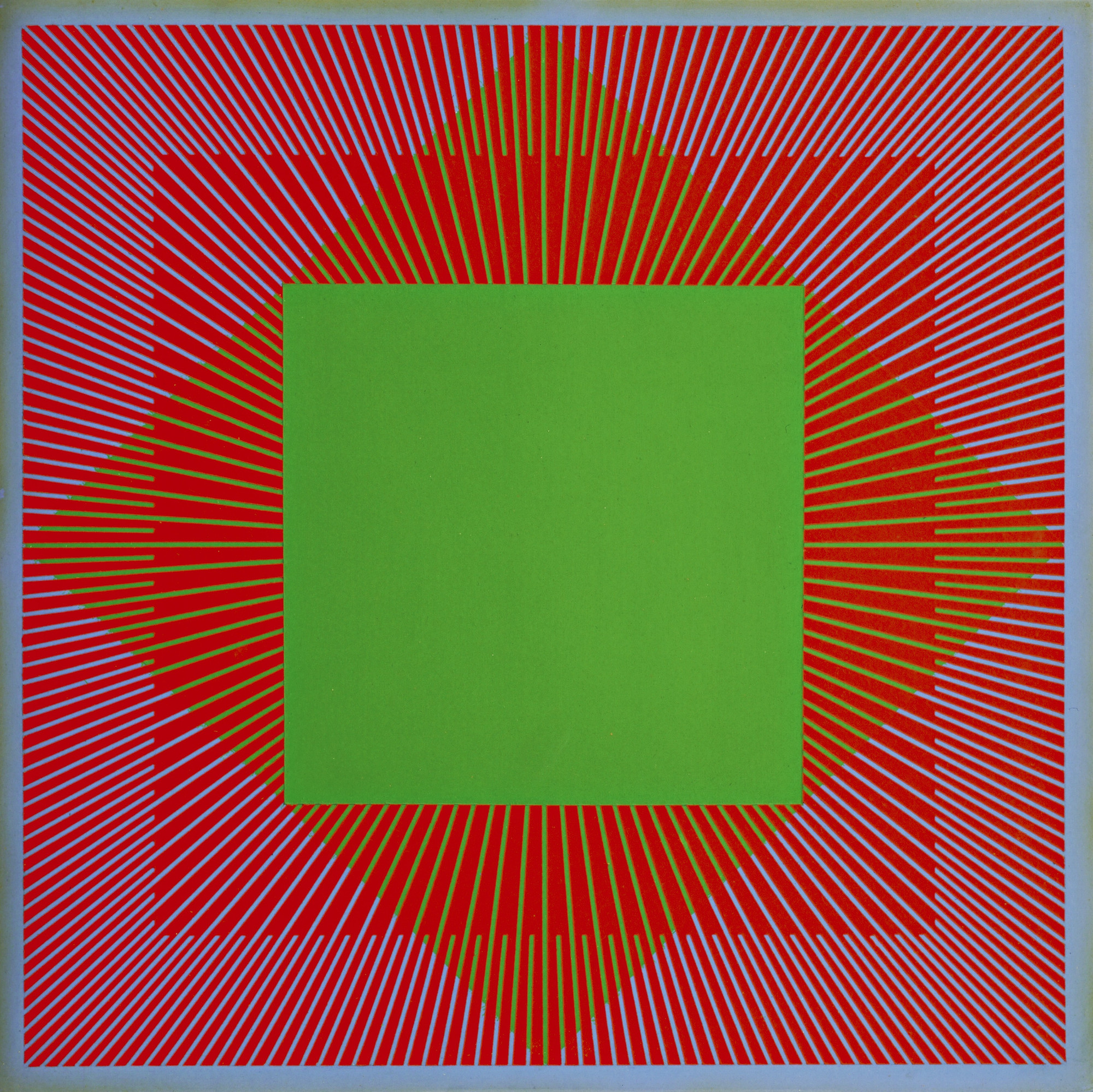
Working in Op Fine art beyond the pond from Vasarely and Riley, Richard Anuszkiewicz focused his oeuvre on colors, peculiarly ones of high intensity, and what they do when are putting in different geometric forms. He studied at the Yale University Schoolhouse of Art and Architecture alongside Josef Albers, whose paintings also partially fall under the Op Art category - only much less so than those of Anuszkiewicz, who was interested in the dynamic, the changes both in atypical colors and the composition as a whole caused by the alter of light.
Heady facts about Op Art: "Look, mum! information technology'due south moving!"
- Op Art has something in common with the "anamorphosis effect", the same baloney used by Leonardo da Vinci during the Renaissance
- Op Art is a product of the 1960s counterculture: The utilise of listen-altering psychedelic drugs such as LSD and mescaline, also in Art.
- Creative person Donald Judd was the first to apply the term "Op art" in his impress review of Polish-born American painter and printmaker Julian Stanczak's exhibition "Optical Paintings". Judd dared to shorten the title and rhyming information technology with ''Pop Fine art".
- «This is ridiculous. 'Optical [paintings],' what does it mean? For other paintings, you don't use your eyes?!», Stanczak responds to the provocation.
- "Gimmicks" was the judgemental label introduced by the famous critic Clement Greenberg to describe Op Art'south motifs.
Written by Petra Chiodi and Angie Kordic
Stay Tuned to Kooness magazine for more heady news from the art world.
Source: https://www.kooness.com/posts/magazine/have-you-ever-wondered-what-op-art-is
0 Response to "Op Art History Characteristics of Optical or Retnal Art"
ارسال یک نظر